By Gbatalibe Uchenna, Henrietta Ibe
The Argungu International Fishing and Cultural Festival, popularly known as the Argungu Fishing Festival, is a four-day annual event held between February and March. The festival symbolizes unity, life, and the beginning of the fishing season in Argungu, a riverside town in Kebbi State, Nigeria. It showcases the rich traditions of the Kebbi people, drawing both local and international visitors.
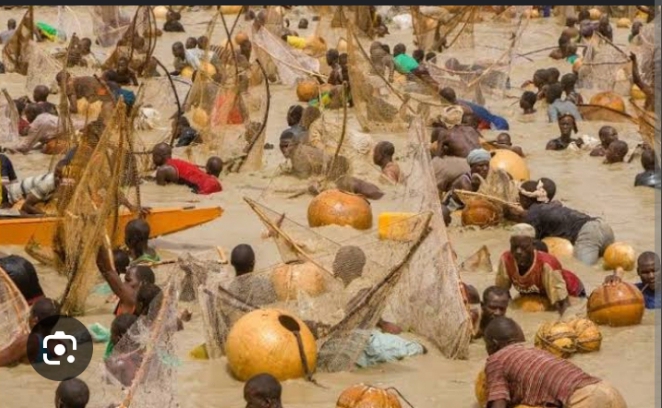
At the heart of the festival is an exciting bare-hand fishing competition, where thousands of fishermen, armed with only a hand net and a large gourd, dive into the Matan Fada River in pursuit of the biggest catch. Men and boys compete fiercely, while women provide encouragement through traditional songs and dances.
For over a century, the Emir of Argungu and the Sultanate of Sokoto were at odds. However, a single act of diplomacy changed history.
In 1925, Mallam Hassan Dan-Mu’azu, the District Head of Dange, learned that the 20th Emir of Argungu was camping on the outskirts of his district while en route to Kaduna. In a remarkable show of goodwill, Mallam Hassan paid him a courtesy visit, sparking an unexpected friendship.
By 1931, Mallam Hassan had become the 16th Sultan of Sokoto. In 1934, he revisited the Emir of Argungu, who, in his honour, organized a grand reception. This event gave birth to what is now the Argungu Fishing Festival.
The Emir soon passed away and was succeeded by his son, Muhammadu Saani, who repaid the Sultan’s visit, an act his father had not lived to fulfill. Their public appearances at the festival helped ease tensions and significantly reduced cross-border raids between their communities.
The festival takes place in Argungu, Kebbi State, within Nigeria’s northwest geopolitical zone. The town, situated on the Sokoto River, is the headquarters of the Argungu Emirate. Events are spread across four key venues:Kabanci, for aquatic cultural activities, Township Stadium for agricultural exhibitions and Matan Fada River, the grand fishing competition site, approximately 50 meters wide and 50 feet deep.
The festival kicks off with electrifying displays of aquatic sports, including: canoe races, swimming competitions (balancing a clay pot on the head), diving contests, wild duck hunting, bare-hand fishing and water relays.
Beyond the water, spectators are entertained by: wrestling and boxing matches, archery tournaments, motor rallies, arts and crafts exhibitions, agricultural showcases, traditional music and dance performances and religious and mystical traditions.
The festival’s spiritual essence lies in its religious rites, which involve prayers for protection and prosperity. These ceremonies, performed by the Homa, Sarkin Ruwa, and Jirgi, include the sacrifice of goats, hens, fruits, and vegetables at the Sokoto River before the festival begins.
The Argungu Festival is also deeply rooted in mystery. The custodian of the Matan Fada River, Hussaini Makwashe (also known as Dangalidaman Makwashe), controls the fate of the fishermen. Until he gives his approval, the fish remain invisible.
A month before the festival, invitations are ritually extended to fish in other connected rivers. Any fish that fails to arrive early is barred from participating in the competition. Even the crocodiles of the Matan Fada River are believed to be in covenant with the Makwashe—on his command, they disappear the day before the event.
The grand finale which is the fishing competition, takes place on the fourth and final day. The Homa signals the start, and thousands of fishermen plunge into the river, battling to catch the largest fish.
Modern fishing tools are strictly forbidden; only traditional nets and gourds are allowed. As the contest intensifies, the air fills with the sound of traditional Kebbawa rhythms, while others shake large gourds filled with seeds to lure the fish into shallow waters.
In 2016, the Argungu Fishing Festival was inscribed on the UNESCO Representative List of the Intangible Cultural Heritage of Humanity. Recognized as a heritage of outstanding universal value, it is preserved to ensure future generations can continue to experience its magic.
Beyond its cultural significance, the festival plays an important role in fish conservation in the Matan Fada River, sustaining the local fishing economy. It also boosts tourism, hospitality, and foreign exchange earnings in Kebbi State and beyond.
When the festival was temporarily suspended, its absence was deeply felt. Its reinstatement marked a return to prosperity, not only for Argungu town but for Nigeria as a whole.