By Edwin Chijindu Nwachukwu, Miracle Ngozi Nnachi
Both art and technology define and continue to reshape the world we live in. Re-imagining what we know as real or as a solid ground pushes our opinions and understandings of nature to the limits and with new inventions and experiments, both the mind and the body, the language, and the world itself seems to be making room for a different sphere and fresh rules. Governed by the new aesthetics, the virtual, the scientific and the logic that is beyond belief, technology in art challenges our perceptions and that is what creativity and science are all about. If we are to understand that creative production reflects the period of time we are all in, how are we to grasp the growing number of young contemporary authors that base their practice on the presentation of immaterial and ephemeral things?
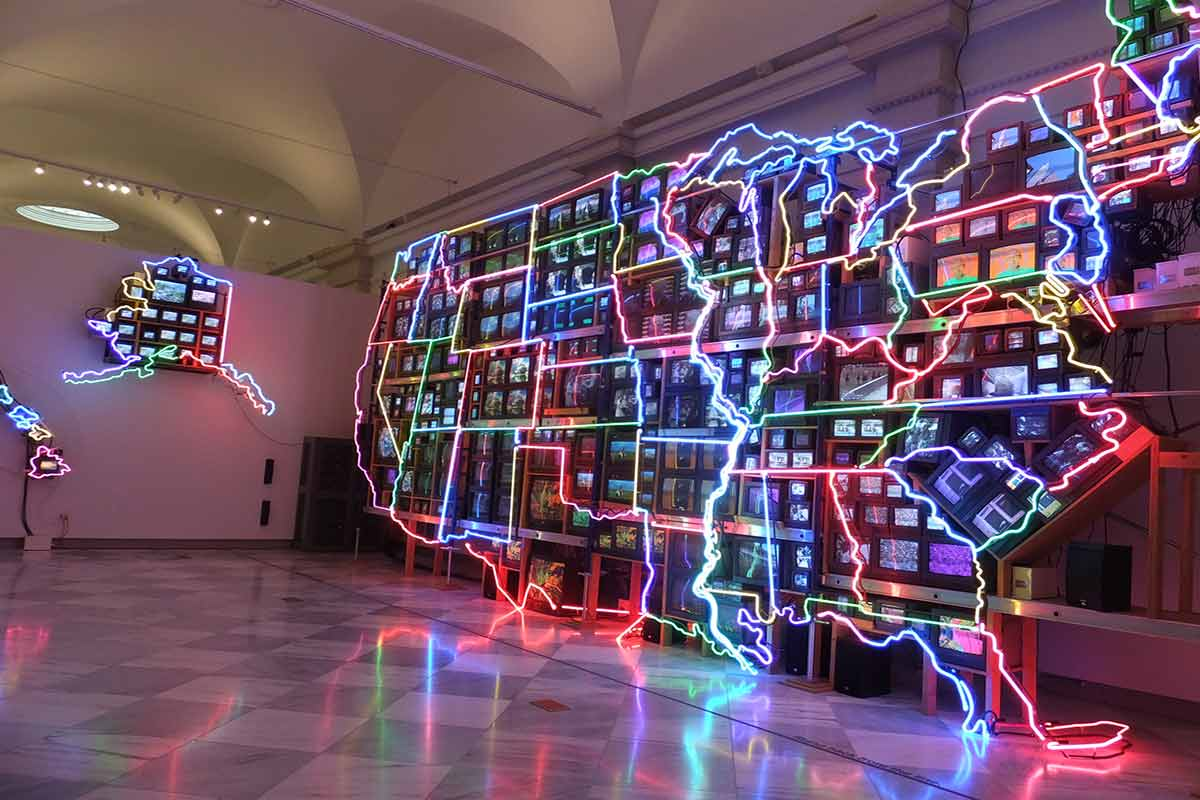
The change of artworks’ nature along with the shift in the public interaction and the reshaping of the museums and exhibition spaces are making more room today than ever before for some of the most amazing examples of art and technology mix through digital art, kinetic pieces, and works that explore the internet and online existence. The sci-fi mysteries of various movies that were mind-blowing just a decade or so, today shape the face of our reality. This part of the innovative computer-based face, the traditional paintings and sculpture cannot capture to its fullest and that is why the fresh materials, such as data, pixels, mathematical and engineer formulas are the tools number of contemporary creatives reach for.
The truth is that technology has been providing creatives with original ways of expression since its beginning. The major shifts, like the transition from the analogue to the digitally created expression, or to even go back further in time, the birth of Impressionism, the famous silkscreen prints of Andy Warhol, or the disturbing performance works by Stelarc would not be possible if technology and science, parallel to the creativities’ road, did not push for original production and new frontiers. Creatives like scientists explore materials, people, culture, histories, religion, and the gained knowledge transform into something else. One of the earliest personas associated with scientific research is the famous Leonardo da Vinci, and to the investigating minds of the 17th-century, we owe the invention of the microscope and the telescope. Along with the investigation of eye’s perception and the color theory, the birth of photography, and the moving pictures of Walt Disney, nothing else has helped to transform activities such as painting, drawing, sculpture, and music than the invention of the computer between 1936 and 1938. With it, a completely different understanding towards the creative production and relationship between art and technology was born.
Since the 1960’s the term new media art was coined and it was used to describe practices that apply computer technology as an essential part of the creative process and production. Placing the term under a vast umbrella known as new media, computer production, video art, computer-based installations, and later the Internet and Post Internet art and exploration of virtual reality became recognized as artistic practices. The term, in contemporary practice, refers to the use of mass production and the manipulation of the virtual world, its tools and programs. As such, designers and artists for the production of commercial pieces or for more elaborate and conceptual works implement many different computer programs, such as 3D modeling, Illustrator, or Photoshop. The engagement of technology and science and the application of its language spread into space and many computer-based installations fuse the conceptual and the new media. With the constant technological developments, the fresh aesthetic was formed and many of the creatives that have chosen to create in the virtual arena of the Internet, comment upon the fusion of the virtual and the real, and question the communication and accessibility of their works in the parallel world. The innovative developments opened up a fresh playground, where different authors could merge different skills and tools and offer to us, as their public, a completely original perspective of the present we all share.
Regardless of what your opinion concerning the relationship between art and technology is, it’s a genuine fact that technology offers something that young aspiring authors always desired which is the untouched grounds to explore, to discover something completely their own and sever ties with whatever is considered to be traditional, giving an opportunity to push the established boundaries. This has been true ever since the first modern steps of technology for example, how the invention of lantern influenced luminism, or how colour tubes allowed painters to paint Plein air and later led them to impressionism, or the time Joseph Nicephore Niepce invented primitive photography and influenced creativity for over 200 years now. As was the case in those periods, the modern time has its own inventions and innovations that are influencing various creatives, effectively being a reflection of the time in which it was made an essential part of art’s nature that will never change. There are many contemporary authors who have decided to say no to brushes and chisels, boldly deciding to venture off into the unknown and test themselves in original techniques that were impossible only a couple of decades ago.
The honour of starting out the list of modern authors who depend on technologies goes to Kim Keever, a modern-day hydroponic artist. This American author devised a method in which he drizzles paint into a 200-gallon fish tank, creating some magnificent effects before taking photos of the colourful chemical reactions. His work is so amazing that it fascinates you whilst also leaving you puzzled, questioning which medium you are actually observing.
Kim Keever learned how to manipulate chemistry thanks to his NASA experiences and scientific background, something that can also be said to some extent about Eric Standley who grew up in a household of engineers. Standley’s paper-cut artworks expand the traditional use of the medium as he works with lasers, shredding with it upwards of 250 sheets of archival paper. The most impressive aspect of his production is the number of details he is able to achieve as his pieces are incredibly detailed and miniature.
A bit more extreme than previous authors on this list, Cai Guo-Qiang is a Chinese author who loves to experiment with the explosive nature of gunpowder and its modern variations, initiating what he loves to call ignition events after the controlled explosion, we are left with traces of an image that are literally burned into the surface. Cai Guo-Qiang also works in installations and performances, often combining many elements of engineering and science in order to achieve the desired effects.
Earning a place on the list due to the playful nature of his artwork is Michael Manning, a man who starts every single one of his works with a computer program, acting out the experience of dabbling in oil paint and later printing them, imitating the physical appearance of an actual acrylic brush stroke. In many ways, Michael Manning’s practice in painting, video, sculpture, and computer-based work explores the relationship between technology and the analog.